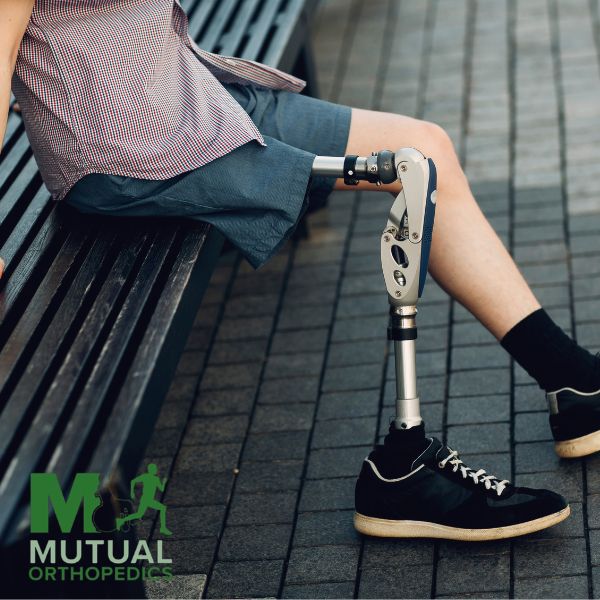
What to Expect in Your First Year with a Lower Limb Prosthesis
The first year after a lower limb amputation is rarely linear. It’s a series of overlapping seasons — healing, fitting, learning to walk, and eventually a definitive prosthesis. Here’s what our team at Mutual Orthopedics has learned across nearly five decades caring for amputees on Long Island.
Weeks 0–6: Healing first
The early weeks belong to your surgical team. You’ll wear a shrinker sock to shape the residual limb, begin pre-prosthetic physical therapy, and may experience phantom sensations — all normal. You won’t meet your prosthetist yet, and that’s intentional: starting too early usually causes setbacks.
Weeks 6–10: Your first prosthetist visit
Once the incision has healed and swelling stabilizes, the fitting process begins. A good prosthetist asks less about componentry and more about your life — your work, your home, your goals. From a cast or 3D scan, we build a test socket designed to be wrong. Adjustments over several visits are where comfort is actually built.
Months 2–4: Learning to walk again
Most patients begin in parallel bars, progress to a walker, then a cane, then walking unassisted. This is not a race. Good gait training focuses on weight bearing, stride symmetry, and hip control — not on looking “normal.”
Daily life
Putting the prosthesis on and off becomes routine. You’ll learn to adjust sock ply as your residual limb changes volume through the day, and to inspect your skin morning and night.
Call your prosthetist if you notice blisters that don’t heal, persistent skin breakdown, sharp pain, or fit changes that sock ply doesn’t resolve. Small problems are easy to fix early.
Months 4–12: Toward a definitive prosthesis
By month six, most patients are walking confidently and tackling stairs, curbs, and a return to work. Between months 8 and 12, your residual limb shape stabilizes — the signal you’re ready for a definitive prosthesis: a refined socket and componentry such as the LIM Infinite Socket, Click Medical RevoFit, or a microprocessor knee like the Ottobock C-Leg or Genium.
The emotional side
Limb loss affects identity, mood, and sleep — even when physical rehab goes well. Progress isn’t linear. Peer support, honest conversations with your care team, and professional mental health support if you need it all matter as much as the device itself.
Whether you’re at week one or year ten, our ABC-certified team welcomes new patients across Suffolk County and Brooklyn. Call 800-707-4445 or request an appointment.
Educational information only. Not a substitute for guidance from your physician, surgeon, or prosthetist.