What Is an AFO and Who Needs One?
At Mutual Orthopedics, we have a broad range of experience with AFOs, KAFOs, and a full spectrum of orthotic care for lower and upper extremity conditions. One of the most frequently asked about devices is the AFO, or Ankle-Foot Orthosis. Whether you’re a parent researching options for your child or an adult dealing with a neurological condition, understanding what an AFO is and how it works is an important first step toward better mobility and quality of life.
What Is an AFO?
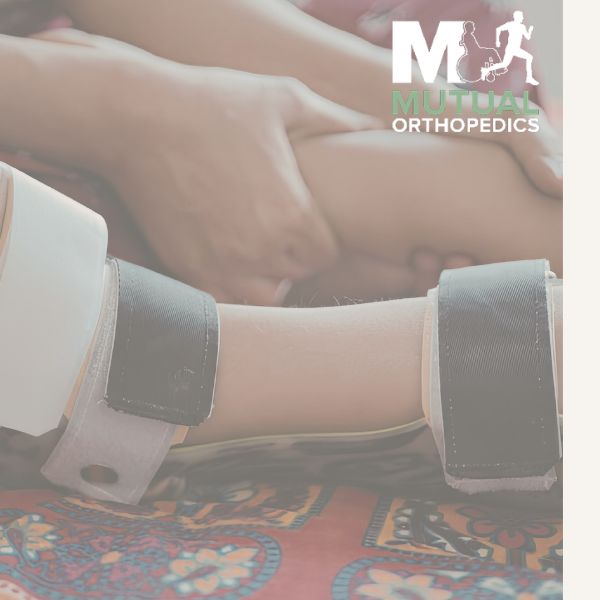
AFO stands for Ankle-Foot Orthosis — a brace that supports the foot and ankle, extending from just below the knee down to the foot plate. An AFO is a device designed to control the position and movement at the ankle joint, improve alignment of the foot, and help patients stand or walk more safely and efficiently. Ankle-foot orthoses are among the most commonly prescribed orthotic devices for both children and adults dealing with lower limb and lower extremity conditions.
How AFOs Work
AFOs work by holding the ankle and foot in proper alignment, preventing the foot from dropping, dragging, or rolling inward or outward. When the foot hits the ground, an AFO helps distribute pressure points evenly and supports a more natural walking pattern. The effect of ankle-foot orthoses on gait can be significant — many patients experience improved mobility, reduced fatigue, and greater confidence when wearing an AFO.
Types of AFOs
There are many different types of AFOs, each designed for specific conditions and levels of support. Understanding the type of AFO that’s right for you depends on your diagnosis, ankle range of motion, and activity level. Common types of AFOs include:
- Rigid AFO / Solid AFO — A solid AFO limits all movement at the ankle, providing maximum support for patients with severe muscle weakness or paralysis.
- Hinged AFO — A hinged AFO allows controlled ankle movement while still providing ankle stability, making it a good option for patients who need support but retain some ankle function.
- Posterior Leaf Spring AFO — A posterior leaf spring AFO is a flexible plastic AFO designed to help prevent the foot from dropping during the swing phase of walking, allowing the foot to clear the ground naturally.
- Dynamic AFO — A dynamic AFO uses flexible materials to provide support while allowing some movement, commonly used for children with cerebral palsy.
- Ground Reaction AFO — A ground reaction AFO is used to improve knee stability and is often used in conjunction with treatment for conditions affecting the lower leg and lower extremities.
- Carbon Fiber AFO — Lightweight and strong, a carbon fiber brace type offers excellent energy return and is popular among active patients.
- Knee Ankle Foot Orthoses (KAFOs) — For patients who need support beyond the ankle, knee ankle foot orthoses extend up the leg to support both the knee and ankle and foot together.
Who Needs an AFO?
AFOs are commonly used to treat a wide range of conditions affecting the leg and foot. Your orthotist may recommend an AFO if you or your child has been diagnosed with:
- Foot Drop — Patients with foot drop have difficulty lifting the front part of the foot, causing it to drag. An AFO can help by holding the ankle at the correct angle and allowing the foot to clear the ground with each step.
- Cerebral Palsy — AFOs are commonly used for children with cerebral palsy to improve alignment, mobility, and walking patterns. A custom AFO may be especially beneficial as the child grows.
- Multiple Sclerosis — Multiple sclerosis can cause muscle weakness and foot drop, making an AFO brace essential for safe and efficient walking.
- Stroke — After a stroke, patients often experience weakness or paralysis on one side of the body, affecting one foot or both lower extremities. AFOs are commonly prescribed to restore function and ankle support.
- Other Neurological and Orthopedic Conditions — AFOs can be used for a wide variety of conditions affecting ankle stability, alignment, and mobility.
Custom AFO vs. Off-the-Shelf Options
While prefabricated braces are available, a custom AFO made specifically for your foot and ankle provides a far superior fit and function. A custom AFO may feel more comfortable, reduce pressure points around the ankle joint, and perform better for your specific diagnosis and lifestyle. Your orthotist will conduct an AFO evaluation to determine the most appropriate AFO for your needs and the types of shoes that will work best with the AFO.
Getting the Right AFO at Mutual Orthopedics
Whether an AFO is needed for a child or an adult, fitting an AFO correctly is critical to its effectiveness. At Mutual Orthopedics, our certified orthotists specialize in custom AFO fabrication and fitting for patients of all ages and conditions, with locations in Islandia and Brooklyn, NY. We take the time to understand your goals, assess your ankle and foot, and recommend the right AFO to support your mobility and independence. Contact us today to schedule your AFO evaluation.