C-Brace vs. Traditional KAFO: What’s Actually Different?
By the Mutual Orthopedics Care Team — Long Island & Brooklyn
If your physician has recommended a knee-ankle-foot orthosis (KAFO), you may already be weighing two very different options: a traditional locked-knee KAFO, or the Ottobock C-Brace. Both braces support a weak leg. They do it in fundamentally different ways — and the right choice depends on you.
How a Traditional KAFO Works
A traditional KAFO locks the knee joint in extension during stance and unlocks it (sometimes manually, sometimes automatically) during the swing phase. It’s a reliable, durable design that has helped patients walk for decades, and it remains the right choice for many.
The tradeoff is gait quality. Walking with a locked knee means a stiff-legged stride, hip-hiking to clear the foot during swing, and stairs descended one step at a time leading with the sound leg. Standing up from a chair often requires manually unlocking and re-locking the joint. On uneven terrain, the locked knee can feel precarious.
How a C-Brace Works
The C-Brace uses sensors that measure knee angle, knee angular velocity, and load on the foot — many times every second. An onboard microprocessor decides, in real time, exactly how much hydraulic resistance the knee should offer at each phase of the gait cycle.
In practice, that means:
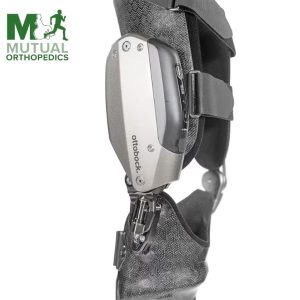
- Controlled knee flexion during stance — your knee bends under control as you bear weight, rather than locking rigidly.
- Free swing during the swing phase — for a more natural gait pattern.
- Step-over-step stair descent — leading with the affected leg, the way most people walk down stairs.
- Smoother sit-to-stand — no manual locking, no abrupt drops into chairs.
- Better performance on ramps, grass, and uneven ground, where the device adapts dynamically.
The Honest Tradeoffs
The C-Brace isn’t strictly “better” than a traditional KAFO. It’s a different tool, with real tradeoffs:
- Cost. The C-Brace is significantly more expensive — though typically covered by Medicare, Medicaid, and most commercial insurers when properly documented.
- Candidacy. Not every patient qualifies. The C-Brace requires lower-limb paresis (not complete paralysis), adequate hip flexion, and cognitive readiness to use the device.
- Complexity. Batteries need charging. Software needs updating. Components require periodic service.
- Water exposure. The C-Brace is splash-resistant but not designed for showering or swimming.
For a patient with complete paralysis, severe contractures, limited cognitive reserve, or one who simply prioritizes simplicity and durability, a traditional KAFO often remains the right answer.
How To Decide
The right brace is the one that fits your body, your goals, and your life. A candidacy evaluation with a certified prosthetist is the only reliable way to know which device is right for you.
If you’d like to compare options on Long Island, our Ottobock-certified team welcomes a candidacy evaluation at either our Islandia or Brooklyn office. Call 800-707-4445 or request an evaluation online.
Educational information only. Not a substitute for clinical evaluation by a certified prosthetist and your treating physicians.